Meta’s AI Muse Rapidly Claims No. 2 US Apps
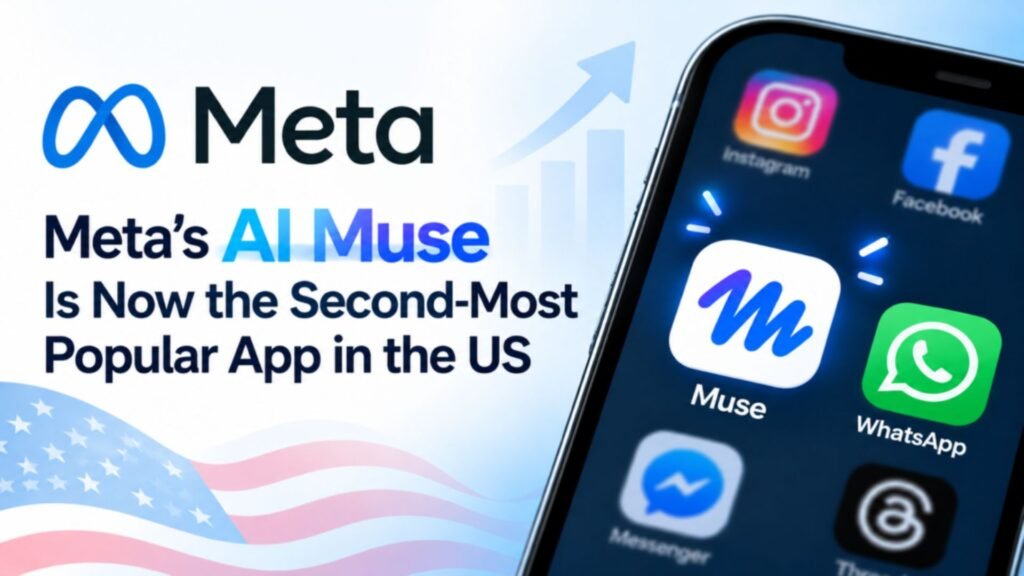
Meta is beginning to gain some goodwill on Wall Street. That shift comes after the company launched Muse, its new AI app, on Tuesday. The company’s overall effort into agentic AI has also become a hot topic on X, particularly among industry insiders. Now, early download figures provide a better picture. They demonstrate Muse’s popularity among its target group of US customers.
Sensor Tower, a market intelligence organization, has released new data on this topic. According to the data, Muse has topped 83,000 iOS downloads in the United States. The app is currently limited to the United States market only.
Muse rose to No. 2 on the App Store’s Top Charts thanks to this volume of downloads. Still, that performance looks modest next to other recent Meta app launches. The data indicate that Threads and Meta AI performed significantly better at launch. Threads, for example, pulled in more than 4.3 million U.S. downloads on its very first day. Upon its launch, Meta AI received 108,000 downloads in the United States.
Muse also lags behind another major consumer AI launch: ChatGPT. ChatGPT had already been installed by half a million people in the United States in less than a week of its release. At the time, the U.S. was also ChatGPT’s only market. ChatGPT received an average of approximately 83,300 downloads per day over the course of that week. Muse achieved the same result roughly twice as quickly.
That said, this doesn’t necessarily signal a weak launch for Muse. However, it may just be building momentum more gradually. The app continues climbing iOS charts.
As of today, it sits at No. 2 on the App Store. On Android, the picture looks different. There, Muse has only reached No. 338 in Productivity.
Google Play. Android-specific download figures aren’t available yet.
Muse is also accessible through the web and via WhatsApp. Neither of those access points factor into the download estimates above. Also Read More on OpenAI Astra Has Reached a New Cybersecurity Milestone
Nonetheless, Muse’s early songs merit attention. One of Meta’s most important bets right now is on the app. The company’s underlying thesis is straightforward: agents that complete tasks on people’s behalf will define the next era of consumer AI. In a move that is arguably as bold as its earlier rebranding from Facebook to Meta when it pursued metaverse ambitions, Meta is putting real weight behind that bet. Of course, Meta isn’t alone in this race.
Nearly every major tech company has entered the consumer agentic AI space in some form. That includes, among others, the Gemini Spark from Google and the Claude Cowork from Anthropic.
But when it comes to simple, mass-market agents built for everyday use, the real competition right now sits between two products: Meta’s Muse and Instinct, a newer AI agent that operates over text messaging. Recently, Instinct was valued at $2.5 billion. Despite lingering security concerns and a privacy policy widely seen as too broad, Silicon Valley insiders keep praising Instinct’s capabilities.
Plenty of other agents exist too, many focused more narrowly on things like work management or family logistics. However, Instinct appears to be the most likely competitor. It has $350 million in funding behind it. It’s also shipping new features at a rapid clip.
Instinct gave each user an email address just this week. The company also revealed plans to build its own social layer, letting a user’s Instinct agent communicate directly with their friends’ agents to help coordinate plans.
If agentic AI really is the future, this social approach could matter a lot. Instinct is essentially building a new kind of social graph, one based on who people genuinely talk to and spend time with in real life. That could end up being more valuable than Meta’s existing friend graph, which blends real friends with people users simply follow.
In the past several days, Instinct has also added integrations with Stripe and 1Password.
It also included a location-sharing feature, allowing the agent to handle tasks that require knowledge of a user’s current location. Timing may have also played a role in Muse’s more modest debut. The app asks users to share more personal data with Meta than usual. It launched just days after Meta agreed to an $18 billion multistate settlement, tied to a lawsuit over social media’s harms to consumers.
That’s far from Meta’s only legal headache over the years. The company has weathered major data scandals in the past. It’s also faced repeated fines from the U.S. Federal Trade Commission over privacy violations.