California Passes the No Robo Bosses Act: AI Can’t Fire Workers Without a Human Check
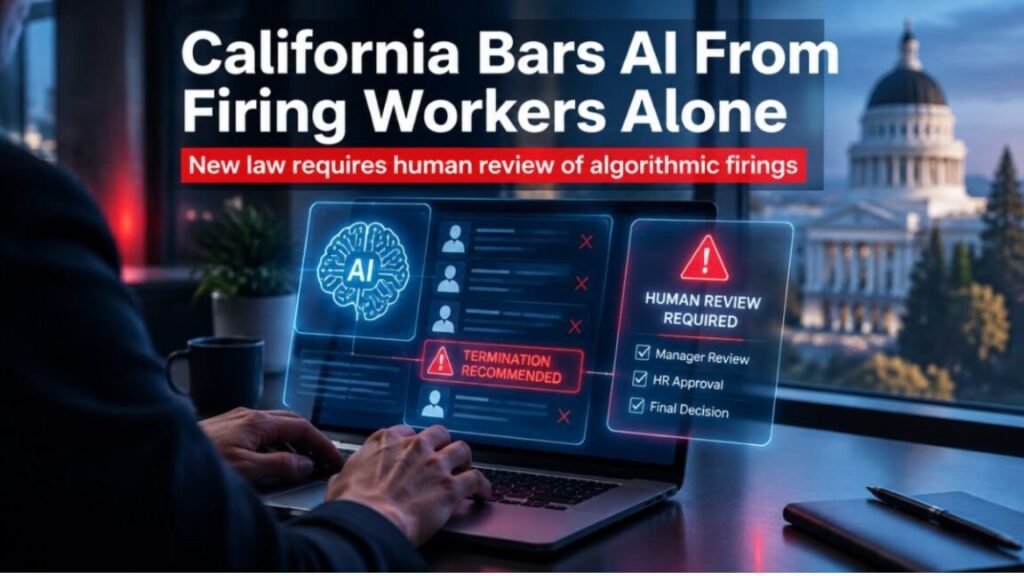
California is the first US state to stop employers from handing firing and discipline decisions entirely to software. On September 30, Governor Gavin Newsom signed SB 947, the No Robo Bosses Act of 2026, which says that when an automated system drives a termination or disciplinary action, a real person must independently verify it. The California AI firing law takes effect on July 1, 2027.
What SB 947 Requires From Employers
State senator Jerry McNerney authored the bill to rein in “bossware,” the automated tools companies use to track productivity, flag weak performance, and sometimes trigger discipline with no manager involved.
Under the law, an employer can’t treat an algorithm’s output as the sole reason to fire or discipline someone. If the system is the main basis for the decision, a human reviewer has to back it up with separate evidence, such as a supervisor’s assessment, coworker feedback, or the employee’s personnel file.
Employers must also give the affected worker a written notice that:
- states an automated system played a primary role in the decision,
- describes what employee data the system relied on, and
- names a person the worker can speak to about the decision.
Enforcement falls to the California labour commissioner, the state attorney general, and local prosecutors.
McNerney’s office pointed to a British study showing AI assistants misrepresent content nearly half the time, and to more than 550 commercial bossware products already in use, as reasons human oversight should be mandatory. The California Federation of Labour Unions, AFL-CIO, sponsored the bill. Its president, Lorena Gonzalez, called the signing a model for how worker-led efforts can curb some of AI’s worst workplace abuses. The full signing announcement is on Senator McNerney’s official site.
What Was Cut: Gig Workers Are Not Covered
Earlier drafts of SB 947 would have protected gig workers too. Newsom vetoed that version in 2025, objecting to its advance-notice rules. When McNerney brought the bill back this year, the gig-worker language and the wider notice requirement were removed, as employment law analysts have observed. The final law protects employees only, not independent contractors who are managed through apps.
That gap is bigger than it sounds. Ride-hailing and delivery platforms already run assignments, ratings, and account deactivations through algorithms with minimal human input. Freelance marketplaces are heading the same way, with job matching, search visibility, and account warnings on sites like Upwork and Fiverr increasingly automated.
So while W-2 workers in California now have a right to human review of an algorithmic firing, millions of people elsewhere have nothing comparable. That includes a large part of Pakistan’s freelance workforce, whose earnings hinge on how a platform’s ranking or moderation system treats their account. If you’re deciding where to build a freelance income, being guru’s guide to freelance marketplaces beyond Fiverr and Upwork is a good place to compare alternatives.
What This Means for Platform Workers
SB 947 stays within California employment law. It doesn’t reach marketplaces that classify workers as contractors, which covers most freelance platforms. A freelancer whose account is flagged or suspended by an automated trust-and-safety system still has no legal right to a human review, in California or anywhere else.
Labor groups behind the bill describe it as a starting point, and similar proposals are moving in other states. The open question is whether that momentum extends to gig and platform work or stays limited to traditional employment.