
Truck Dispatcher Business Plan: How to Build One Step by Step

A truck dispatcher business plan defines how a dispatch company will serve motor carriers, acquire clients, perform dispatch operations, generate revenue, control costs, and grow. A complete plan should cover the business model, target market, services, operations, marketing, legal considerations, technology, and financial projections.
The U.S. Small Business Administration (SBA) describes a business plan as a roadmap for structuring, operating, and growing a business. Its recommended planning areas include company description, market analysis, organization, marketing, financial projections, and supporting documents.
What Is a Truck Dispatcher Business Plan?
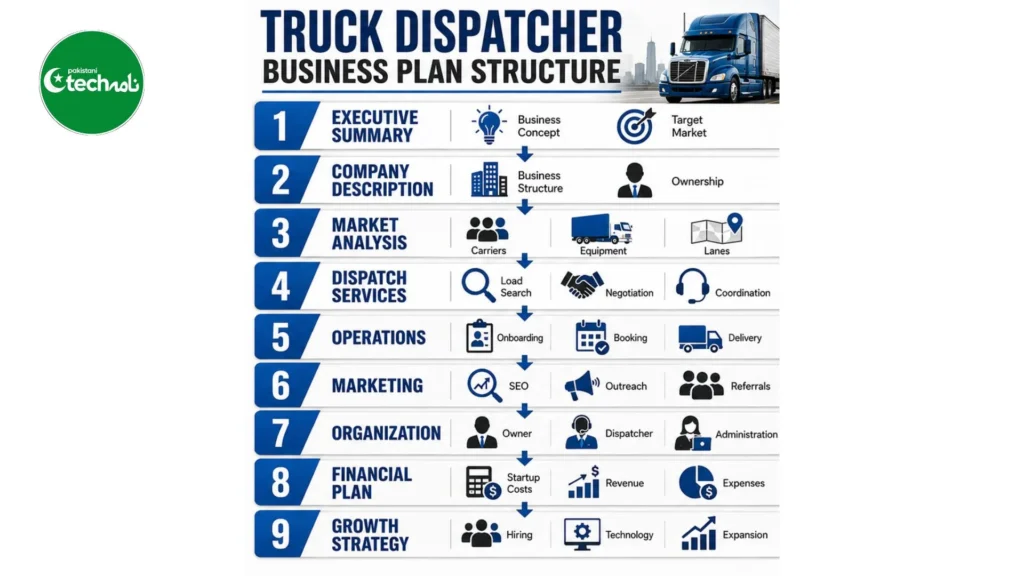
A truck dispatcher business plan is a structured document that explains how a truck dispatching company will operate and generate revenue.
The plan should identify:
- Target customers
- Dispatch services
- Business structure
- Operating process
- Technology requirements
- Customer acquisition methods
- Pricing model
- Startup costs
- Monthly expenses
- Revenue projections
- Growth objectives
The central customer is normally a motor carrier, such as an owner-operator or trucking company. The dispatcher performs defined services for the carrier according to the business relationship and applicable requirements.
What Should a Truck Dispatcher Business Plan Include?
A complete plan should contain 9 major sections: executive summary, company description, market analysis, services, operations, marketing, organization, financial plan, and growth strategy.
| Section | Main Purpose | Key Information |
| Executive summary | Define the business | Mission, market, services |
| Company description | Establish the company | Structure, location, ownership |
| Market analysis | Define customers | Carriers, equipment, lanes |
| Services | Define the offer | Load search, negotiation, coordination |
| Operations | Explain workflow | Carrier onboarding through delivery |
| Marketing | Acquire customers | Website, outreach, referrals |
| Organization | Assign responsibilities | Owner, dispatchers, administration |
| Financial plan | Measure economics | Costs, revenue, cash flow |
| Growth strategy | Plan expansion | Hiring, technology, additional carriers |
This structure follows the general business-planning principles recommended by the SBA while adapting them to the truck dispatching industry.
Who Is the Target Market for a Truck Dispatching Business?
The target market should identify the specific carriers the dispatch company intends to serve.
Possible customer segments include:
- Owner-operators
- Small trucking companies
- Small fleets
- Motor carriers
- Specialized carriers
- Dry van carriers
- Reefer carriers
- Flatbed carriers
- Box truck operators
The plan should define the customer segment, equipment type, geographic market, preferred freight, and service requirements.
For example, a new dispatch company could target small motor carriers operating dry van equipment rather than attempting to serve every equipment category immediately.
This creates a defined market position and makes customer acquisition, service design, and operational procedures easier to organize.
What Services Should a Truck Dispatcher Offer?
A truck dispatching business should clearly define the services included in its carrier agreement.
Potential services include:
- Load searching
- Load qualification
- Broker communication
- Freight rate negotiation
- Load booking
- Rate confirmation management
- Pickup and delivery coordination
- Driver communication
- Document organization
- Detention or layover communication
The exact service scope should be defined in the carrier-dispatch agreement.
A dispatcher should also understand the legal distinction between dispatch services and freight brokerage. FMCSA issued final guidance in 2023 explaining how the definitions of broker and bona fide agent apply to transportation arrangements. The regulatory relationship should therefore be reviewed before establishing operating procedures.
How Does a Truck Dispatching Business Make Money?
A truck dispatching business generates revenue by charging carriers for dispatch services according to its agreed pricing structure.
Common pricing structures can include:
- Percentage-based fees
- Flat fees
- Per-load charges
- Other contractually defined service fees
The business plan should specify what generates the fee, when the fee becomes payable, and which services are included.
For example, if a dispatch company uses a percentage-based model, its financial projection can calculate:
Dispatch revenue = carrier freight revenue × agreed dispatch percentage
If a carrier generates $10,000 in monthly freight revenue and the contractual dispatch fee is 5%, the dispatch company’s gross service revenue from that carrier would be:
$10,000 × 5% = $500
This is gross service revenue before business expenses, taxes, refunds, payment-processing costs, software, salaries, and other operating costs.
What Are the Startup Costs for a Truck Dispatching Business?
Startup costs depend on the business structure, location, technology, staffing model, marketing strategy, and regulatory or professional requirements.
A startup-cost plan should separate one-time costs from recurring costs.
One-time costs
- Business formation
- Website development
- Computer equipment
- Office equipment
- Initial branding
- Legal document preparation
Recurring costs
- Internet service
- Phone service
- Dispatch software
- Load-board access
- CRM software
- Accounting
- Insurance where applicable
- Advertising
- Employee or contractor payments
The SBA recommends calculating startup costs before launch and using those costs to understand funding requirements and financial needs.
How Does Truck Dispatching Operations Work?
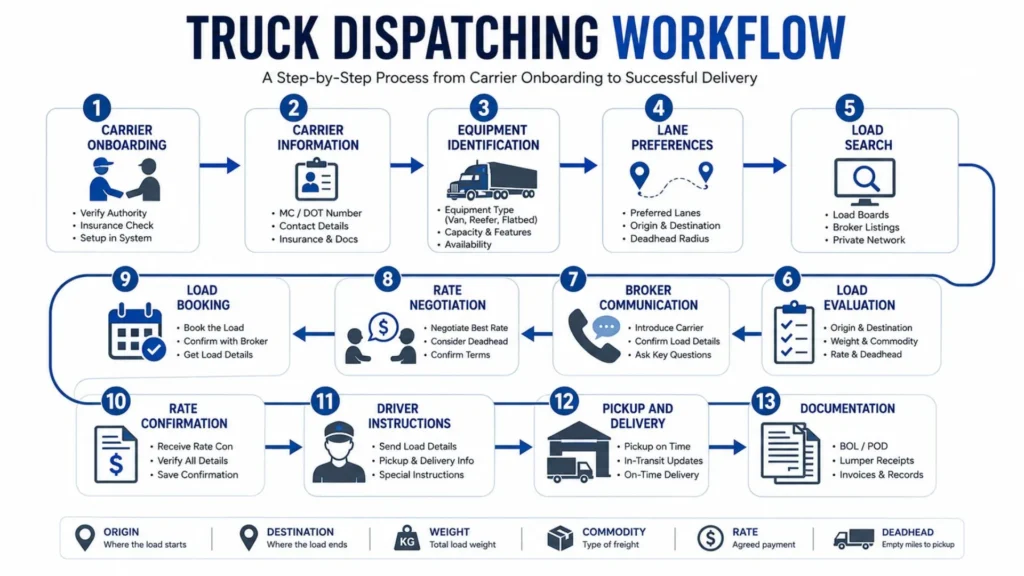
The operating plan should describe the complete dispatch workflow.
A practical sequence is:
Carrier onboarding → carrier information → equipment identification → lane preferences → load search → load evaluation → broker communication → rate negotiation → load booking → rate confirmation → driver instructions → pickup → delivery → documentation.
Each stage should have a defined responsibility and record.
For example, the load evaluation stage can consider:
- Pickup location
- Delivery location
- Pickup date
- Delivery date
- Equipment
- Commodity
- Weight
- Total rate
- Rate per mile
- Deadhead
- Carrier preferences
This information allows the dispatcher to determine whether a load fits the carrier’s operating requirements.
How Should a Truck Dispatch Business Find Customers?
Customer acquisition should be a separate section of the business plan.
Potential channels include:
- Search engine optimization
- Business website
- Direct outreach
- Email marketing
- Referrals
- Industry networking
- Social media
- Partnerships
The plan should define a measurable acquisition process.
For example:
Prospects contacted → responses → qualified carriers → consultations → agreements → active carriers
This creates measurable sales stages instead of treating marketing as a general activity.
The SBA recommends market research and competitive analysis to understand customers, competitors, industry conditions, and opportunities before launching a business.
What Technology Does a Truck Dispatching Business Need?
Technology should support the actual dispatch workflow.
A basic technology stack can include:
- Computer
- Business email
- Business phone
- Load-board access
- Dispatch management software
- Customer relationship management software
- Cloud document storage
- Accounting software
- Electronic communication tools
The business plan should identify each system’s purpose.
For example, a CRM can organize prospective and active carrier relationships, while dispatch software can organize operational information associated with loads and carriers.
How Should You Create Financial Projections?
Financial projections should connect expected carrier volume with pricing and operating expenses.
A basic monthly model can use:
Monthly revenue = number of active carriers × average monthly carrier revenue × dispatch fee percentage
Suppose a hypothetical dispatch company has:
- 10 active carriers
- $12,000 average monthly freight revenue per carrier
- 5% dispatch fee
The projected monthly gross service revenue would be:
10 × $12,000 × 5% = $6,000
If monthly operating expenses were $2,500, the simplified operating surplus before taxes and other adjustments would be:
$6,000 − $2,500 = $3,500
These are planning assumptions, not guaranteed results. Actual revenue depends on carrier volume, freight activity, contractual fees, operating expenses, client retention, and other business variables.
The SBA recommends using financial projections to connect business plans with expected financial performance. For businesses seeking financing, it recommends detailed projections and more specific first-year forecasting.
How Many Trucks Should a New Dispatcher Plan to Handle?
A new business should define capacity based on its workflow, staffing, technology, and service level rather than selecting an arbitrary truck count.
The capacity model should measure:
- Active carriers
- Trucks per carrier
- Loads handled
- Loads per dispatcher
- Daily communication volume
- Administrative workload
- Customer response requirements
If one dispatcher is responsible for 10 carriers and each carrier requires different communication and load-management activity, the business should measure actual workload before increasing the carrier base.
Capacity should therefore be treated as an operational metric in the business plan.
What Legal and Compliance Issues Should the Plan Address?
The plan should identify the company’s business structure, contracts, insurance requirements, tax obligations, and applicable transportation regulations.
The most important distinction is between a dispatch service, bona fide agent, and freight broker.
FMCSA’s final guidance addresses circumstances involving broker authority and bona fide agents. A business should evaluate its actual activities and contractual relationships rather than assuming that calling itself a “dispatch service” determines its regulatory status.
Legal requirements can also vary according to jurisdiction and business activity. Professional legal and regulatory advice should be obtained when the operating model is unclear.
What Should the First-Year Truck Dispatch Business Plan Target?
The first-year plan should use measurable operational targets.
A planning table can include:
| Metric | Example planning target |
| Active carriers | 10 |
| Monthly carrier revenue | $12,000 each |
| Dispatch fee | 5% |
| Projected monthly gross service revenue | $6,000 |
| Monthly operating expenses | $2,500 |
| Simplified operating surplus | $3,500 |
These values are illustrative assumptions, not industry averages.
The actual plan should replace them with figures based on the company’s pricing, customer research, operating costs, and expected carrier acquisition rate.
How Do You Write a Truck Dispatcher Business Plan Step by Step?
Follow this sequence:
- Define the dispatch business model.
- Identify the target carrier segment.
- Select the equipment categories to serve.
- Define the dispatch services.
- Research competitors and customer requirements.
- Document the dispatch workflow.
- Select required technology.
- Create the customer acquisition strategy.
- Define the pricing and revenue model.
- Calculate startup and recurring costs.
- Build monthly revenue projections.
- Calculate the break-even point.
- Document legal and contractual requirements.
- Set first-year operational targets.
- Review the plan and update assumptions.
What Makes a Truck Dispatcher Business Plan Effective?
A useful plan connects customers, services, operations, revenue, costs, and growth.
The strongest structure is therefore:
Target carrier → required service → dispatch workflow → technology → pricing → revenue → operating cost → profit calculation → growth capacity.
The plan should also remain a working document. The SBA describes business plans as tools for guiding a company through startup, management, and growth rather than documents that exist only for initial formation.
Frequently Asked Questions
Is a truck dispatcher business profitable?
Do I need a business plan for a truck dispatching business?
How much money do I need to start a truck dispatching business?
How does a truck dispatcher get paid?
Is a truck dispatcher the same as a freight broker?
What should a truck dispatcher business plan include?
Conclusion
A truck dispatcher business plan should explain who the company serves, what services it provides, how dispatch operations work, how the company acquires carriers, how it generates revenue, what it costs to operate, and how it will scale.
The core planning sequence is:
Market → Carrier → Service → Operation → Technology → Pricing → Revenue → Costs → Capacity → Growth.
This structure keeps the business plan connected to the actual truck dispatching business rather than treating business planning, dispatch operations, and financial management as unrelated subjects.