
Nvidia’s AI Edge Is Expanding Beyond GPUs
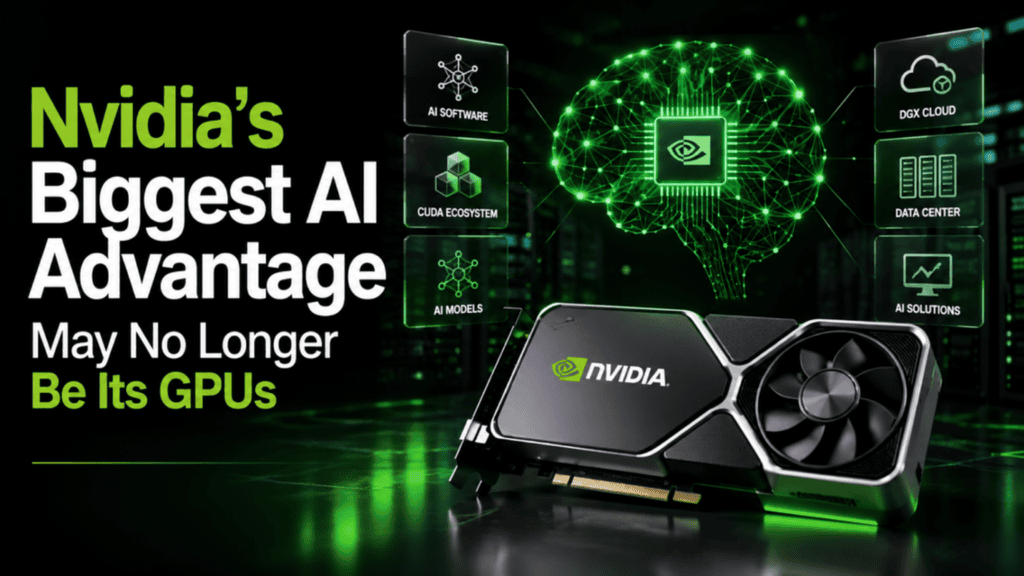
For much of the artificial intelligence boom, Nvidia’s biggest competitive advantage has been its powerful graphics processing units (GPUs). The company became the leading supplier of the computing hardware needed to train and run advanced AI models, generating enormous growth as demand surged.
That landscape, however, is changing.
Major cloud companies such as Amazon and Google have developed their own AI chips, giving customers alternatives to Nvidia’s hardware. As a result, investors have increasingly questioned whether Nvidia can maintain its dominant position as competition in AI processors grows.
Nvidia’s market value increased by roughly ten times between the beginning of 2023 and the middle of 2025. Since then, its share-price growth has become more moderate, with concerns about competition contributing to the change in investor sentiment.
But Nvidia’s latest developments suggest its competitive advantage may not depend entirely on the GPU anymore.
The AI Infrastructure Challenge Is Getting Bigger
As AI data centers expand toward gigawatt-scale computing capacity, simply having powerful processors is no longer enough.
Companies must also ensure that enormous quantities of data can move between processors, memory, storage and networking systems without creating bottlenecks.
This has created a new infrastructure challenge: coordinating the entire computing system as efficiently as possible.
Nvidia has increasingly positioned itself as a provider of complete AI computing systems rather than simply a GPU manufacturer.
That could become an important advantage as AI deployments continue to grow.
Nvidia Is Building Complete AI Racks
Nvidia’s Vera Rubin architecture provides an example of this broader strategy.
The platform combines the Rubin GPU with other specialized components, including the Vera CPU and Groq 3 LPX inference accelerator. Storage and networking technologies are also integrated into the overall system.
The significance of these components is that they are designed to work together rather than operate as isolated pieces of hardware.
If the GPU is viewed as the engine of an AI system, these supporting technologies perform many of the functions needed to keep that engine operating efficiently.
The Role of the Vera CPU
One of the key challenges is moving data between storage, memory and computing resources at the right time.
Jason Hardy, Nvidia’s vice president of storage technology, said the amount of memory that can be placed inside an individual server or computing platform is limited.
As AI systems become larger, memory and storage requirements increase as well. Companies such as Micron have benefited from this growing demand for AI infrastructure.
However, having large amounts of storage and memory is only part of the problem. Data must reach the GPU quickly enough to prevent expensive computing resources from sitting idle.
Nvidia says its Vera CPU can help accelerate these operations.
Hardy said the company has observed improvements of up to three times in certain operations, allowing flash storage performance to be used more effectively without creating bottlenecks.
The broader objective is to maximize the amount of useful computing achieved for every unit of energy consumed.
OpenAI Is Tackling the Same Problem Differently
The challenge of moving data efficiently is not unique to Nvidia.
OpenAI’s Jalapeño chip reportedly takes a different approach by attempting to reduce data movement rather than simply improving how information is transported.
OpenAI explained that the architecture was designed to minimize communication delays by keeping workloads within a connected system.
The underlying principle is similar even though the implementation is different.
Instead of relying solely on faster processors, companies are increasingly looking at how the entire computing architecture can reduce delays and improve efficiency.
This creates another competitive layer in AI infrastructure.
The Battle Is Moving Beyond the GPU
The growing importance of data movement and system coordination does not mean Nvidia has automatically secured another long-term monopoly.
The company will still face competition from traditional chipmakers as well as cloud providers developing their own hardware.
However, the competitive landscape is becoming broader.
In the past, building a faster or more efficient GPU was one of the primary ways to challenge Nvidia. As AI infrastructure becomes more complex, a competing company may need to optimize the entire computing stack instead.
That includes processors, memory, storage, networking and the systems responsible for coordinating data between them.
Nvidia has spent years developing many of these components alongside its GPUs, giving it an established position as AI computing moves toward increasingly integrated systems.
The company’s biggest AI advantage, therefore, may increasingly be the ability to make all of its hardware work together efficiently—not simply the performance of its GPUs alone.
For more useful information visit: https://pakistanitechnama.pk/