
Microsoft’s $10 Billion Gulf Bet: Why It’s About More Than Data Centers
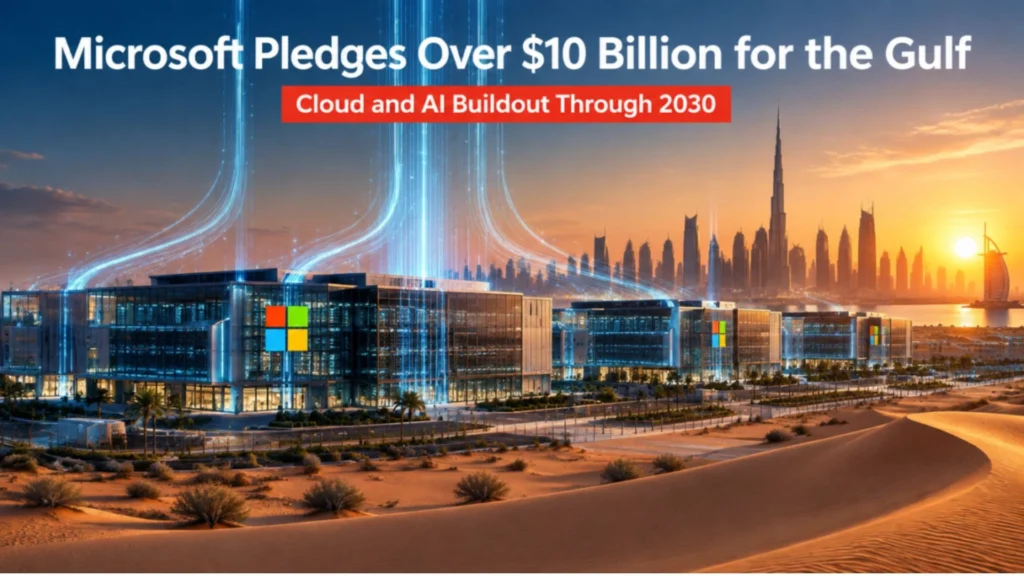
Microsoft used its appearance at the UN General Assembly on September 23, 2026 to lay out a new spending plan for the Gulf: more than $10 billion in combined capital and operating investment across the UAE, Saudi Arabia, Qatar, and Kuwait through 2030. It’s the company’s first major update to its regional strategy since fighting in Iran rattled the Middle East earlier this year — and that timing is doing a lot of the messaging work here.
The Numbers Behind the Headline
The $10 billion figure sounds like a fresh commitment, but roughly $7.9 billion of it was already pledged to the UAE last year. Strip that out and the genuinely new money is closer to $2 billion. Alongside this, Microsoft is putting over $400 million into subsea and land-based connectivity across the region by 2030 — infrastructure meant to speed up cross-border data flow and cut latency for cloud and AI applications. The company is also rolling out a dedicated cybersecurity team across all four countries and expanding its AI for Good Labs, which apply AI tools to education, healthcare, and agriculture.
Sovereignty, Not Just Growth
What’s notable is how Microsoft is framing this. Vice chair Brad Smith tied the investment explicitly to regional instability, arguing that recent conflict has sharpened the link between digital resilience and digital sovereignty for Gulf nations. Microsoft’s Middle East and Africa president, Naim Yazbeck, pushed a similar message: the region isn’t waiting to be handed an AI future — it’s building its own.
That’s a deliberate pivot from “look how much we’re investing” to “we’re helping you protect yourselves.” It also isn’t happening in a vacuum — Microsoft already holds a $1.5 billion stake in Abu Dhabi’s G42 and is co-building the Stargate data center project with G42 and OpenAI. This announcement extends work already in motion rather than starting something new.
The Part That Matters for Workers
Buried under the investment total is arguably the more interesting number: Microsoft says it wants to help 4.2 million people across the four countries gain AI-related skills by 2030. For the large population of South Asian and Pakistani workers already employed in the Gulf, that training pipeline — plus the construction and cloud jobs the buildout will create — is arguably more tangible than the headline dollar figure. Big infrastructure spending tends to ripple outward too, boosting demand for everything from IT support to marketing and content work.
Microsoft isn’t the only player here — AWS, Google Cloud, and Oracle have all announced their own Gulf expansions in the past couple of years, and regional governments have made courting this kind of investment a policy priority. What sets this one apart is pairing serious skills investment with the capital spend, though it’ll take a year or so to see whether the training numbers actually translate into hiring.
For freelancers or professionals in the region, these skills programs typically aren’t citizens-only — they usually run as public-private partnerships open to residents and expats. A certification earned through one of these programs is a more verifiable credential to put in front of clients than simply pointing at Microsoft’s investment news.